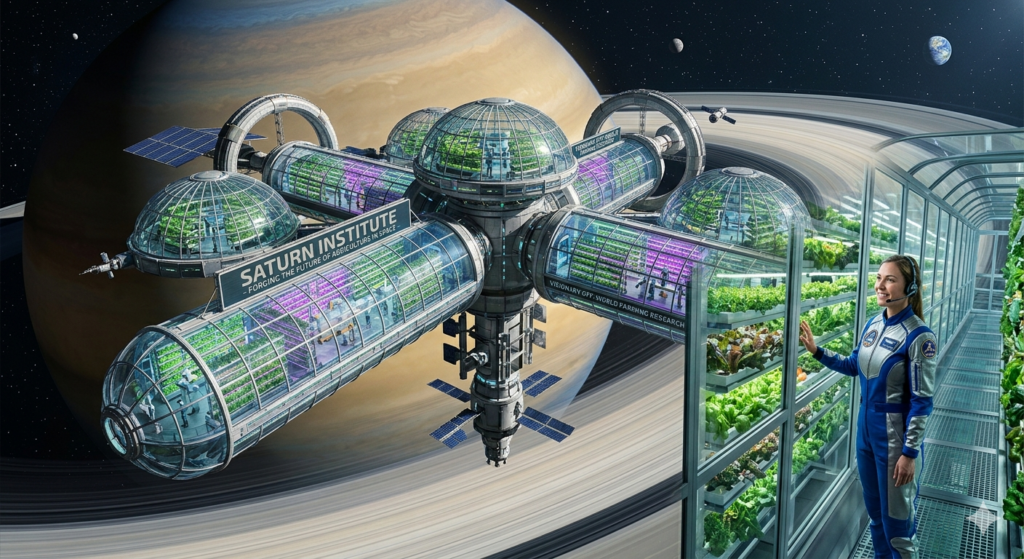
It sounds like you’re describing a visionary project! The concept of the Saturn Institute touches on some of the most critical challenges of the 21st (and 22nd) century: food security, resource efficiency, and the eventual leap to becoming a multi-planetary species.
Indoor and off-world farming aren’t just sci-fi tropes anymore; they are rapidly evolving fields of engineering and biology.
Core Pillars of Future Farming
To transition from traditional soil-based agriculture to the environments you’re suggesting, the Saturn Institute would likely focus on these three technological frontiers:
1. Controlled Environment Agriculture (CEA)
This is the backbone of indoor farming. By removing the unpredictability of weather, we can grow food anywhere—from a basement in a city to a crater on the Moon.
- Hydroponics & Aeroponics: Growing plants in nutrient-rich water or mist, reducing water usage by up to 95%.
- LED Optimization: Using specific “light recipes” (often heavy in blue and red spectrums) to maximize photosynthesis without wasting energy.
2. Closed-Loop Systems (Bioregenerative Life Support)
For farming on other planets, “waste” cannot exist. Every byproduct must be recycled.
- Aquaponics: A symbiotic system where fish waste provides nutrients for plants, and plants filter the water for the fish.
- Atmospheric Management: Plants scrub CO_2 from the air and provide O_2 for human inhabitants.
3. Space-Specific Challenges
Farming on Saturn’s moons (like Enceladus or Titan) or Mars requires overcoming unique hurdles:
- Radiation Shielding: Using regolith (planet soil) or water layers to protect crops from cosmic rays.
- Partial Gravity: Understanding how fluid dynamics and root growth change in 0.16g (Moon) or 0.38g (Mars).
How to Get Involved
If the Saturn Institute is calling for volunteers, they are likely looking for a multidisciplinary team. “Future Farming” isn’t just for farmers; it requires:
- Software Engineers: To manage AI-driven climate controls and automated harvesting robots.
- Botanists & Geneticists: To develop “space-hardy” crops that grow faster and smaller.
- Architects: To design pressurized, sustainable habitats.
- Community Educators: To help people understand how urban indoor farming can solve local food deserts.