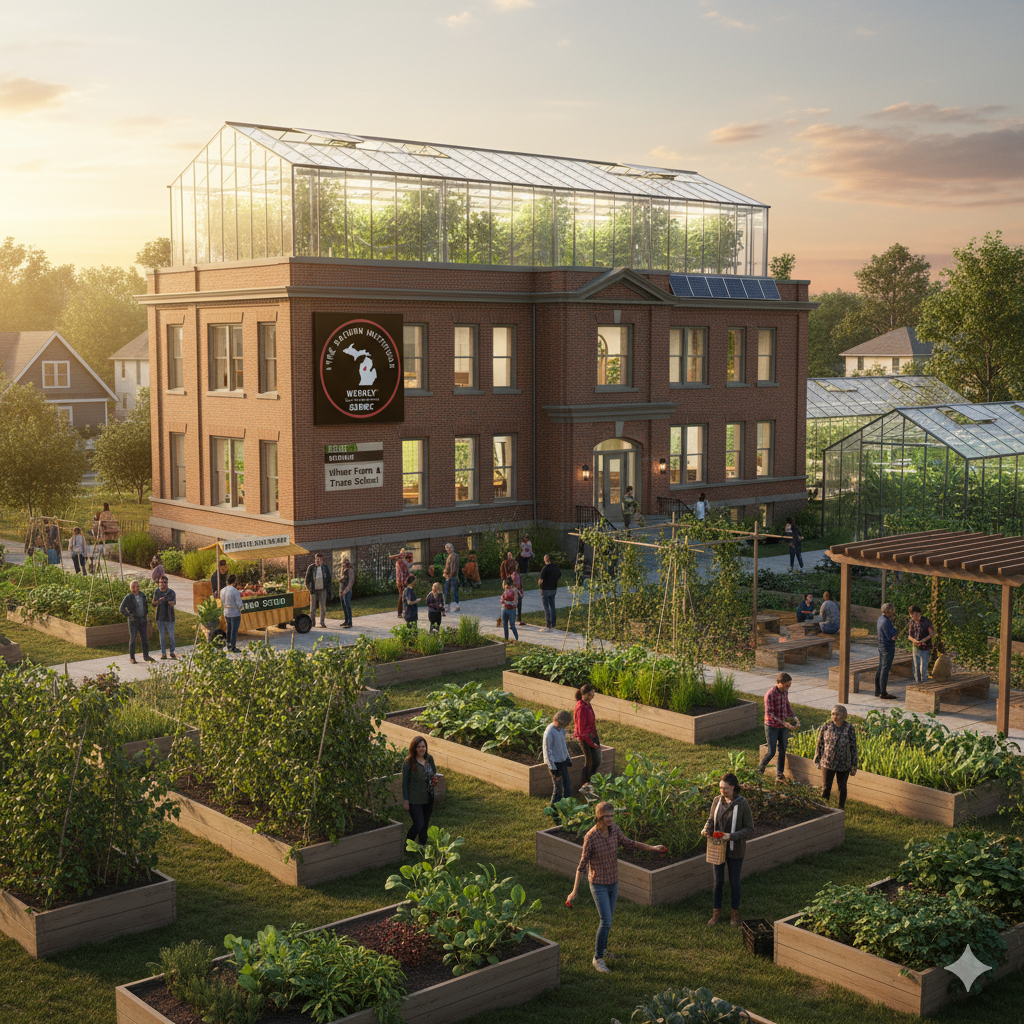
Executive SummaryThe Saturn Institute, a 501(c)(3) non-profit organization, is proposing the development of a state-of-the-art urban agriculture and trade school in Pontiac, Michigan. This project will transform a 100,000 square foot former school on an 8-acre campus into a community hub for agricultural education, skill development, and food production. With a total project budget of $26 million, the institute will offer hands-on training for all ages, focusing on sustainable farming practices, food processing, and related trades.Our mission is to empower the community, foster self-sufficiency, and create a sustainable model for urban revitalization through education and hands-on experience. The project is “renovation-as-we-grow,” with fundraising efforts directly supporting phased construction and operational costs.
1. Mission and Vision:
* Mission: To provide a comprehensive, accessible, and community-driven trade school that teaches the art and science of sustainable urban agriculture, fostering economic empowerment and food security in Pontiac, Michigan.
* Vision: To be a beacon of innovation and hope, transforming a disused urban space into a thriving center of learning and production, and serving as a national model for community-based agricultural education.
2. The Opportunity & Market Analysis:
* Location: Pontiac, Michigan, a city with a population of over 60,000, has a median household income of approximately $42,791 and a significant percentage of its population living in poverty. This creates a strong need for accessible, job-training programs that can lead to economic empowerment.
* Urban Agriculture Trend: There is a growing national and global movement towards urban agriculture as a solution for food deserts, community health issues, and economic development. The project aligns perfectly with this trend, providing a unique and timely solution for the Pontiac community.
* Educational Need: There is a documented need for trade and vocational training programs that offer tangible skills. The Saturn Institute will address this by providing certification programs and workshops in areas that are both practical and in-demand.3. Programs and ServicesThe institute will offer a multi-faceted approach to education, catering to various age groups and skill levels.
* Trade School Programs:
* Urban Farming Certification: A comprehensive program covering soil science, hydroponics, aquaponics, vertical farming, pest management, and crop rotation.
* Agricultural Mechanics & Technology: Training in the maintenance and operation of modern farming equipment, including automated systems for indoor farming.
* Food Processing & Preservation: Workshops on canning, freezing, and other methods to extend the shelf life of produce, with a focus on value-added products.
* Community Supported Agriculture (CSA) Management: Hands-on experience in managing a CSA program, including marketing, distribution, and customer relations.
* Business & Entrepreneurship in Agriculture: Courses on developing a small-scale farm business, including financial management, marketing, and sales.
* Community Education & Outreach:
* Youth Programs: After-school programs and summer camps teaching children and teenagers about gardening, nutrition, and food systems. * Community Workshops: Free or low-cost workshops for community members on topics such as home gardening, composting, and healthy cooking.
* On-site Farmer’s Market: A space for the community to purchase fresh, locally grown produce from the institute’s farm.
4. Operations Plan:
* Initial Phase (Fundraising & Planning):
* Secure initial “seed” funding to begin phased renovations.
* Establish a Board of Directors and an Advisory Committee of local community leaders, agricultural experts, and educators.
* Develop a detailed architectural and engineering plan for the building and land.
* Initiate marketing and outreach campaigns to build community support.
* Phase 1 (First-Year Renovations & Launch): * Renovate a portion of the 100,000 sq ft building (e.g., 10,000 sq ft) for a demonstration farm and initial classroom space.
* Begin on-site agricultural production and establish the first courses and community workshops. * Hire an Executive Director, Farm Manager, and initial instructors.
* Launch the “Saturn Institute Quarterly” and media initiatives to promote the project and generate awareness.
* Subsequent Phases (Expansion):
* As funding allows, continue phased renovations, building out additional classrooms, labs, processing kitchens, and administrative offices.
* Expand the curriculum to include more advanced certifications and new trades.
* Scale up production on the 8-acre property, establishing outdoor plots, greenhouses, and livestock pens (if part of the long-term vision). * Develop partnerships with local businesses, restaurants, and school districts.
5. Financial Plan & Funding Model
* Total Project Cost: $26,000,000. This is an estimated cost, based on typical school renovation costs in the Midwest (ranging from $300-$500 per square foot, or $30M-$50M for 100,000 sq ft), with the total being conservative and manageable via phased development.
* Revenue Streams (Earned Income):
* Program Fees: Tuition and fees for trade school certification programs (Scholarships will be available).
* Produce Sales: Revenue from the sale of fresh and processed food to the community, local businesses, and restaurants.
* Rental Fees: Potential for renting out event space or commercial kitchens to local food entrepreneurs.
* Funding Sources (Contributed Income): As a 501(c)(3) non-profit, all donations are tax-deductible to the fullest extent of the law. The strategy will focus on a diversified fundraising approach:
* Foundation Grants: Targeting foundations with a focus on urban revitalization, education, food security, and environmental sustainability. Examples include the USDA’s Urban Agriculture and Innovative Production Grants, Kellogg Foundation, and other local and national foundations.
* Corporate Partnerships & Sponsorships: Seeking support from local businesses and corporations interested in corporate social responsibility (CSR) initiatives.
* Individual Philanthropy: Major gift campaigns targeting high-net-worth individuals and families. * Community Fundraising: Grassroots campaigns, crowdfunding, and community events to engage the public and secure small-dollar donations. This will be an ongoing effort to build a broad base of support.
* Government Grants: Exploring grants from federal, state, and local governments for educational projects, workforce development, and urban agriculture.6. Management Team
* The Saturn Institute Leadership: The current leadership will guide the mission and vision, leveraging their connections and expertise to build a strong foundation.
* Executive Director: A full-time, experienced non-profit leader who will be responsible for fundraising, strategic planning, and overall operations. * Program Director: An experienced educator to develop and oversee the curriculum, ensuring its relevance and quality.
* Farm Manager: A skilled agricultural professional to manage all farming operations, from planting to harvesting.
* Board of Directors: A dedicated board with diverse skills in finance, law, education, agriculture, and community relations.
7. ConclusionThe Saturn Institute’s project in Pontiac is more than a renovation; it’s a model for community revitalization. By converting a vacant building into a vibrant hub for agricultural education, we will create jobs, foster self-sufficiency, and provide the community with access to fresh, healthy food. The “renovate-as-we-grow” model ensures that every dollar raised directly translates to tangible progress, allowing the community to witness the transformation firsthand. With a clear vision, a phased financial model, and a strong community-centric approach, The Saturn Institute is positioned to create a lasting and positive impact on the city of Pontiac.